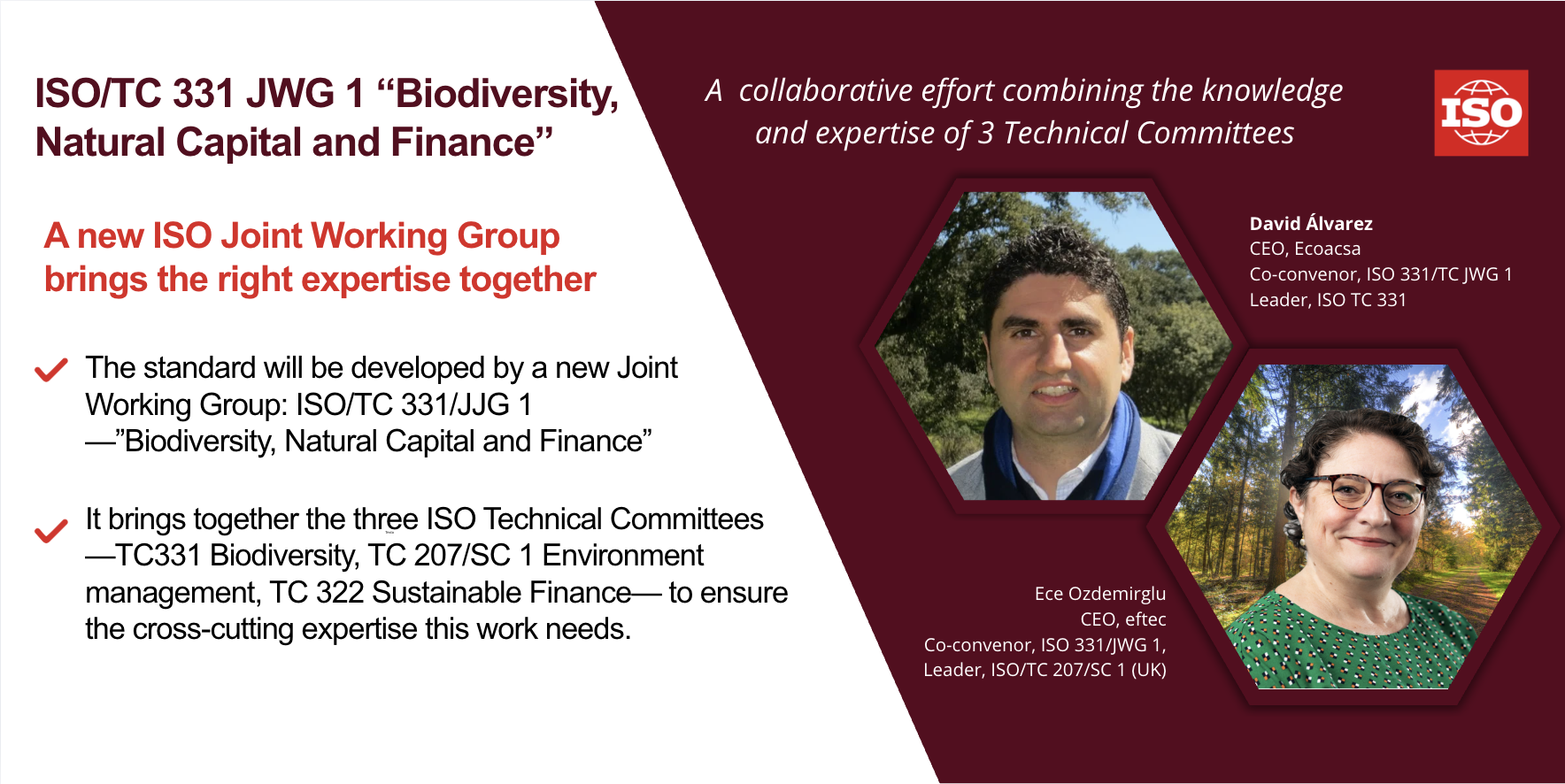
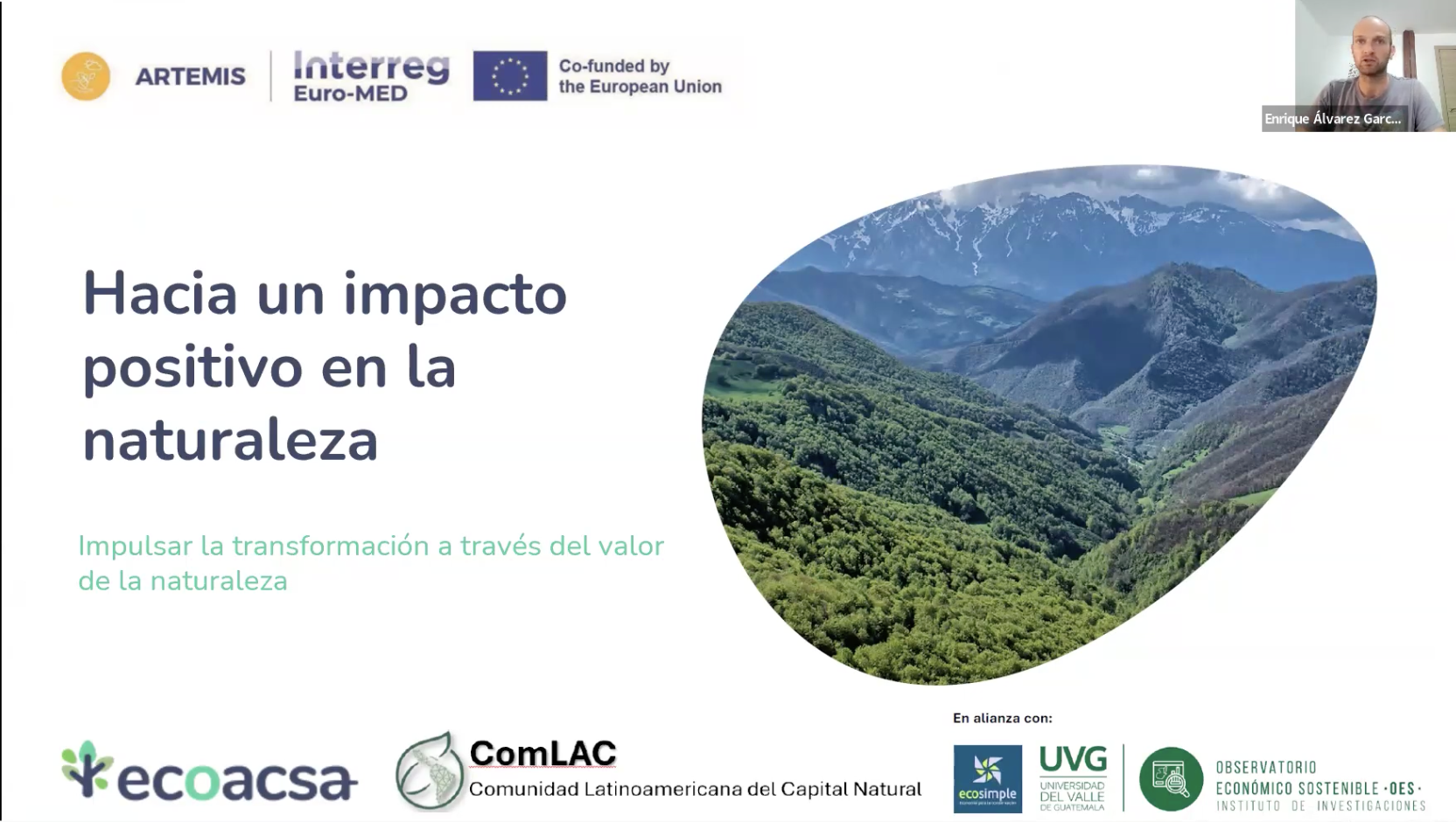
How can we move from talking about biodiversity to measuring it, managing it and integrating it into real decision-making? This was one of the central questions addressed during the webinar “Natural capital in business: standards, measurement and application”, organised by the Latin American Natural Capital Community (ComLAC), organised by the Comunidad Latinoamericana del Capital Natural (ComLAC) on May 27, with the participation of David Álvarez García, CEO of Ecoacsa, Director of Natural Capital Factory and coordinator of the European Interreg Euro-MED project, and Enrique Álvarez García, Senior Consultant in Natural Capital and Biodiversity at Ecoacsa and technical coordinator of ARTEMIS.
David addressed the role of natural capital in business and presented different frameworks, standards and initiatives that are helping to bring nature measurement and valuation into the corporate sphere.
For his part, Enrique presented a practical case study developed within the framework of ARTEMIS on the application of Natural Capital Accounting to seagrass restoration and its connection with innovative financing mechanisms.
The session was moderated by Juan Pablo Castañeda, from the Sustainable Economic Observatory of the Universidad del Valle de Guatemala, and was held in partnership with Ecosimple, the Universidad del Valle de Guatemala and the Sustainable Economic Observatory, with the support of Ecoacsa and Natural Capital Factory.
From natural capital to business decision-making
During the first part of the webinar, David Álvarez García explained that one of today’s major challenges is to better connect information generated at business level with data available at public, regional or national level. This connection is key to ensuring that nature-related data can serve both companies that need to assess their impacts, dependencies, risks and opportunities, and public authorities seeking to improve their policies, environmental information systems and planning processes.
From the perspective of ARTEMIS, this approach is particularly relevant, as the project works precisely on integrating ecological, economic and financial information to accelerate seagrass restoration in the Mediterranean and help ensure that its benefits can be incorporated into policies, investment programmes and financial instruments.
David Álvarez stressed that the measurement and modelling of natural capital should not remain solely within the technical sphere, but should be made visible and useful for decision-makers. To achieve this, he highlighted the importance of governance frameworks, standards and tools capable of translating ecological information into a language that companies, investors, public authorities and other economic actors can understand.
In this context, he presented initiatives such as Capitals Coalition, the role of Natural Capital Factory as the Spanish hub , and the evolution of different frameworks aimed at integrating capitals —natural, social, human and produced— into business management and decision-making processes. He also referred to recent standards linked to natural capital accounting and corporate biodiversity, which seek to strengthen the comparability, transparency and usefulness of nature-related information.
ARTEMIS as a practical case study in marine natural capital accounting
The second part of the session was led by Enrique Álvarez García, who presented the work developed under ARTEMIS as an example of applying Natural Capital Accounting (NCA) to seagrass restoration and to the development of financing mechanisms in the Mediterranean basin.
ARTEMIS, funded by the Interreg Euro-MED project, works to accelerate the restoration of Posidonia oceanica meadows and other seagrass ecosystems, combining ecological science, economic valuation and innovative financial solutions. The project includes four Mediterranean pilots: Crete, Menorca, Sardinia and Monfalcone, the latter focused on Cymodocea nodosa. Cymodocea nodosa.
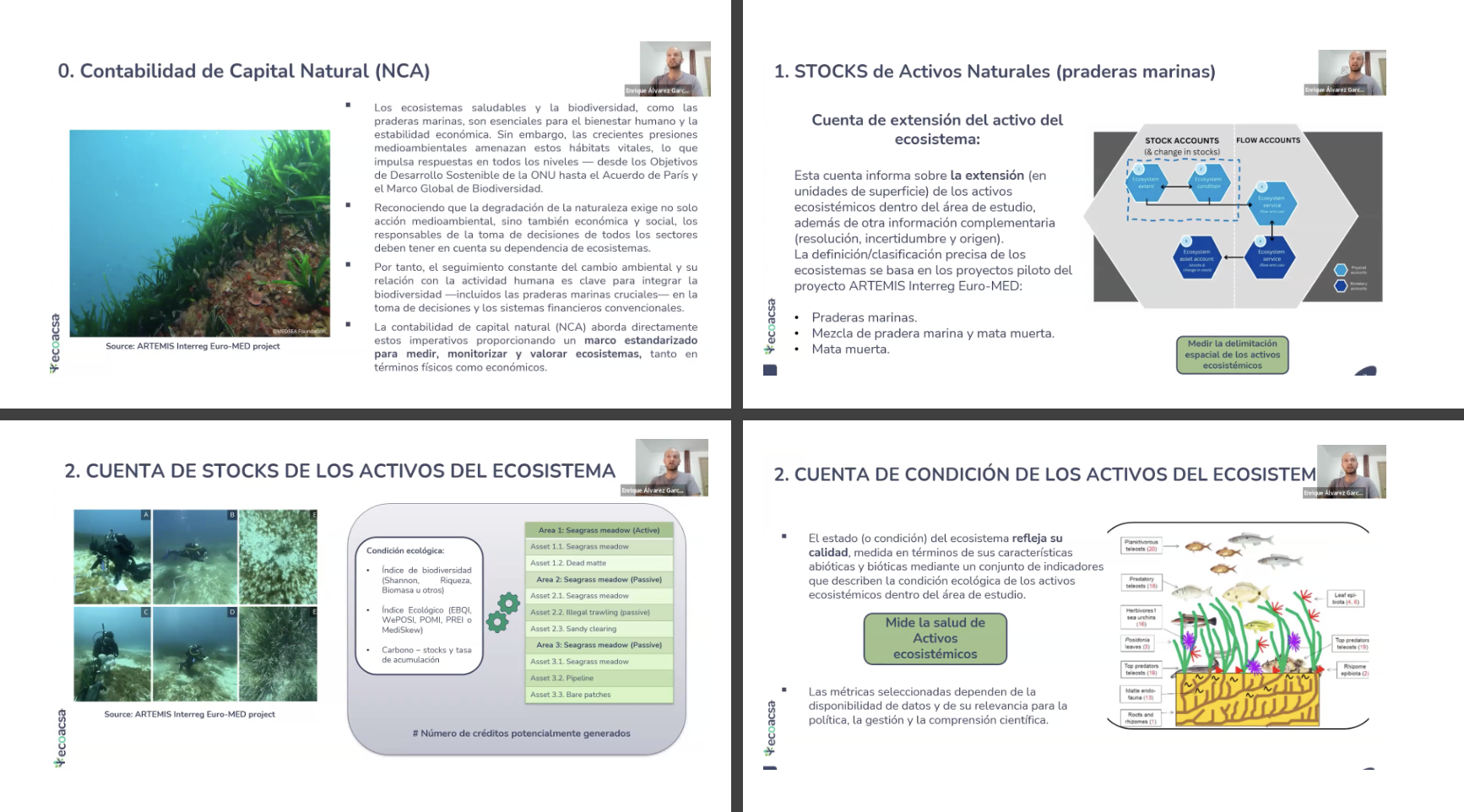
During his presentation, Enrique explained how natural capital accounting makes it possible to transform ecological information collected in the field —such as data on ecosystem extent, condition, biodiversity or blue carbon— into useful information for management, investment and decision-making.
This approach makes it possible to analyse seagrass meadows as natural capital assets, measure their condition and evolution, quantify the flows of ecosystem services they provide and economically value some of their benefits, such as global climate regulation or biodiversity preservation.
Measuring to finance restoration more effectively
One of the key messages shared during the webinar was that marine ecosystem restoration cannot rely solely on public funding or one-off projects. Scaling up restoration and conservation actions requires robust, traceable and comparable information capable of justifying investments and supporting the development of new nature financing mechanisms.
In this regard, Enrique Álvarez presented how the natural capital accounting work developed under ARTEMIS connects with the design of a seagrass credit system. Through this approach, the ecological outcomes of restoration can be linked to verifiable units of value, helping generate price signals and facilitate dialogue with potential investors, public authorities and other actors interested in supporting marine restoration.
The system developed under ARTEMIS is conceived as a flexible and evolving approach, based on the measurement of ecosystem extent and condition, the valuation of ecosystem services and the establishment of monitoring, reporting and verification mechanisms. Its aim is to help build trust in an emerging market in which transparency, data quality and scientific credibility are essential.
A bridge between Europe and Latin America
Ecoacsa’s participation in this webinar made it possible to share with the Latin American Natural Capital Community some of the main lessons generated through ARTEMIS on the measurement, valuation and financing of marine restoration.
During the discussion that followed, participants addressed issues related to data quality, the need to improve the availability of environmental information and the role of natural capital accounting frameworks in better connecting science, public policy, business and finance.
The session highlighted the value of creating spaces for exchange between regions and professional communities working towards similar goals: making nature visible in decision-making, demonstrating with data the benefits provided by ecosystems, and mobilising resources for their conservation and restoration.
Through ARTEMIS, Ecoacsa continues to contribute to the development of tools capable of integrating the ecological, social and economic value of seagrass meadows into policies, financial instruments and investment programmes, advancing towards models that can restore key ecosystems for biodiversity, climate resilience and the well-being of coastal communities.
More information about Interreg Euro-MED ARTEMIS project:
https://artemis.interreg-euro-med.eu/