How can we know whether a particular intervention is genuinely improving an agricultural or livestock farm? Beyond intuition and years of practical experience, having access to data that allows us to observe, measure and assess results is becoming an essential tool for making better-informed decisions.
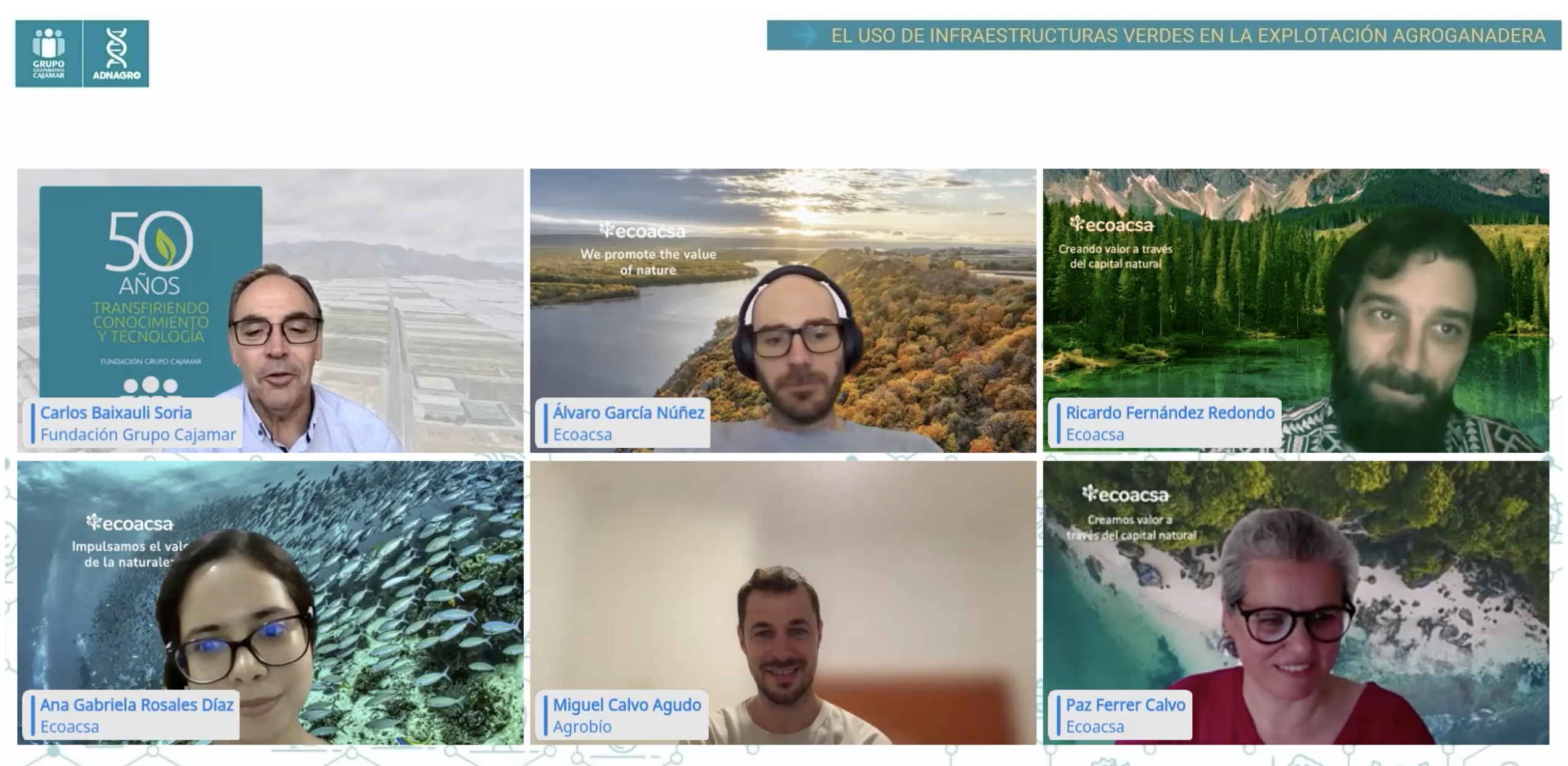
With this idea as the guiding theme, Fundación Grupo Cajamar and Ecoacsa organised the webinar «Green infrastructure in agricultural and livestock farms: Observing and measuring to make better decisions through practice», un encuentro centrado en compartir experiencias sobre ganadería extensiva, biodiversidad funcional, control biológico y soluciones basadas en la naturaleza aplicadas al sector agroganadero.
From experience to data-driven decision-making
The session was opened by Carlos Baixauli Soria, Director of the Fundación Grupo Cajamar Experimental Centre, and Álvaro García Núñez, Project Manager and Senior Consultant at Ecoacsa. Ecoacsa.
Baixauli highlighted the potential of green infrastructure to enhance biological pest control and harness natural processes as allies of agricultural and livestock production. Álvaro García stressed that the experience of those managing farms remains irreplaceable, but that the growing complexity of today's environmental, economic and regulatory context makes it essential to complement that experience with tools capable of measuring results and turning information into better decisions. As he summarised during his presentation, “Observation is essential; measurement helps us understand, and understanding helps us make better decisions."
Measuring the value generated by nature
The following presentation was delivered by Ricardo Fernández Redondo, Technical Consultant in Biodiversity and Natural Capital, and Ana Gabriela Rosales Díaz, from Ecoacsa's Technical Department, who presented the work carried out within the GAD-EX Laboratory, promoted by the Agricultural and Agri-food Technology Centre (ITAGRA) and the Las Loras UNESCO Global Geopark.
Using this practical case study, they demonstrated how it is possible to objectively measure some of the benefits that extensive livestock farming provides to the territory through indicators related to ecosystem condition and the ecosystem services they deliver. Their presentation highlighted the importance of establishing a baseline that makes it possible to assess changes over time and demonstrate, through evidence, the value these practices generate both for biodiversity and for livestock farming itself.
The second technical session featured Carlos Baixauli and Miguel Calvo AgudoField Development Technician in the R&D Department at Agrobío, who presented practical examples of cover crops, flower strips and other forms of green infrastructure that promote functional biodiversity and biological pest control in agricultural systems. Their experiences demonstrated that these measures not only generate environmental benefits, but can also improve farm efficiency and reduce dependence on certain treatments when properly designed, implemented and monitored.
Nature HUB: Free training to learn how to apply, observe and measure nature-based solutions
The webinar concluded with a presentation by Paz Ferrer Calvo, Communications Director at Ecoacsa, who introduced Nature HUB, a training platform designed to bring nature-based solutions, regenerative agriculture and regenerative livestock farming closer to agricultural and livestock professionals through a highly practical learning approach.
During her presentation, she explained that, despite the diversity of the case studies presented throughout the webinar, they all shared the same underlying principle: harnessing natural processes to simultaneously improve farm productivity, biodiversity, soil health, water resources and the resilience of agricultural systems. However, she also stressed that these approaches can only become widespread and fully effective if practitioners have access to tools that enable them to monitor their implementation, measure their outcomes and assess the benefits they generate.
Within this context, she presented the two free online courses offered by Ecoacsa as part of Nature HUB, a project supported by the Fundación Biodiversidad of Spain's Ministry for the Ecological Transition and the Demographic Challenge (MITERD) under the Empleaverde+ Programme, co-funded by the European Social Fund Plus (ESF+):
- Nature-based solutions as a tool for the ecological transition (70 hours)
- Nature-based solutions: Measurement and valuation (60 hours)
Both courses form part of a broader training pathway developed jointly by Fundación Andanatura, Fundación Agroecosistemas, aleJAB and Ecoacsa within the Empleaverde+ Programme.
The training combines technical knowledge, real-life case studies and communities of practice to help professionals, job seekers and future entrants to the sector integrate nature-based solutions into their daily work. Participants learn not only how to implement these approaches, but also how to evaluate whether they are delivering the expected results, understand the benefits they generate and use this information to improve the management of both their farms and the wider landscape.