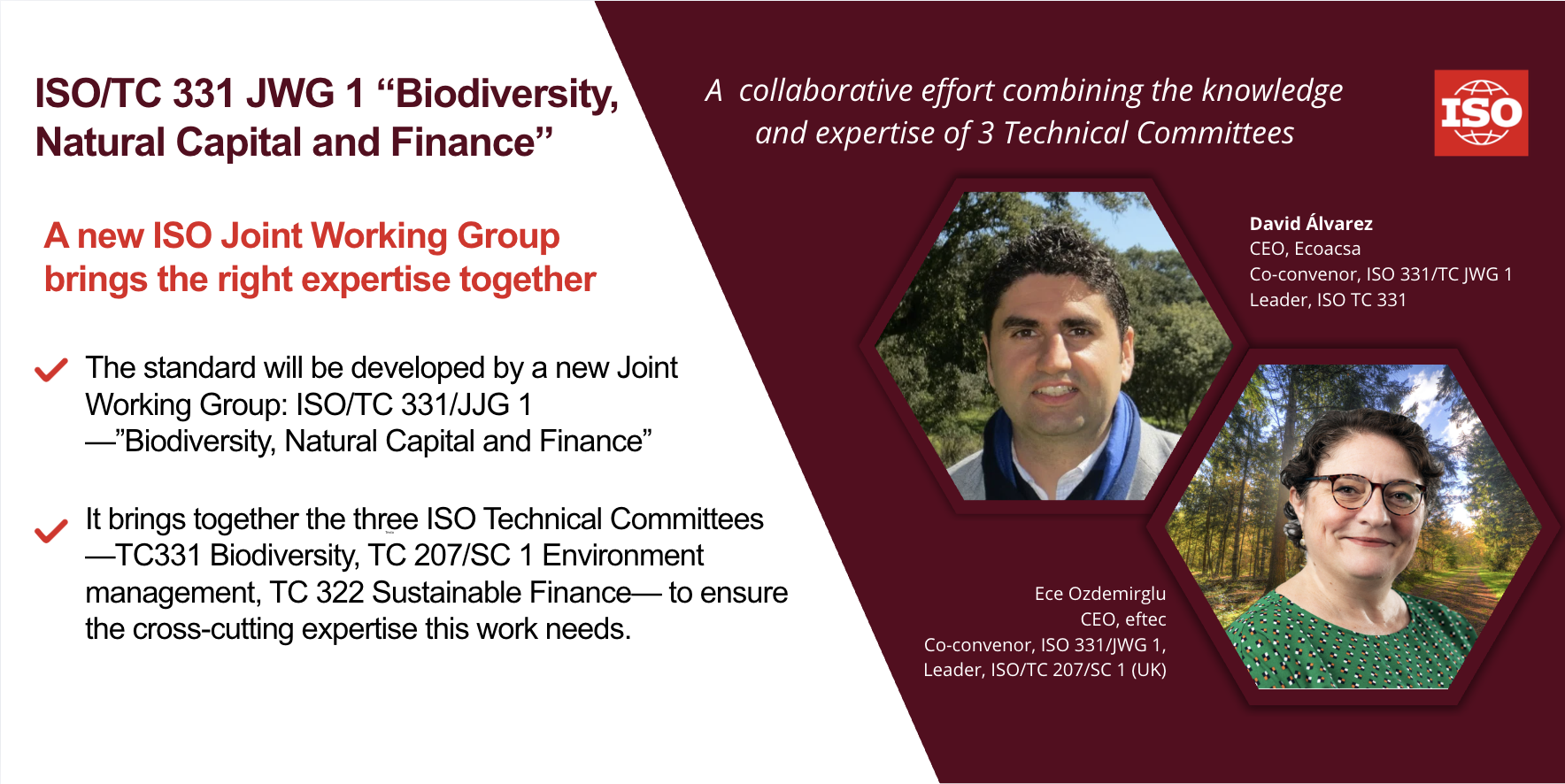
The International Organization for Standardization (ISO) has established a new Joint Working Group, ISO/TC 331/JWG 1 “Biodiversity, Natural Capital and Finance”, co-convened by David Álvarez García, CEO of Ecoacsa, representing the Biodiversity Technical Committee (ISO/TC 331), and Ece Ozdemiroglu, representing the UK's Environmental Management Systems Subcommittee (ISO/TC 207/SC 1).
The establishment of this new group marks an important step forward in collaboration across different areas of international standardization, with the aim of connecting biodiversity and natural capital with environmental management and sustainable finance.
The group brings together experts from three ISO technical committees: ISO/TC 331 (Biodiversity), ISO/TC 207/SC 1 (Environmental management systems) and ISO/TC 322 (Sustainable finance).
This interdisciplinary collaboration will bring together knowledge and expertise from all three fields to develop international tools and standards that help organisations identify, assess and manage their relationships with nature, and integrate nature-related considerations into business and financial decision-making.
A new international standard for assessing nature-related risks and opportunities
The first standardization project to be undertaken by the new group is ISO/AWI 26239, “Identification and assessment of nature-related issues: the LEAP (Locate, Evaluate, Assess, Prepare) approach”, whose development was approved in late September 2026.
This future international standard builds on the LEAP approach originally developed by the Taskforce on Nature-related Financial Disclosures (TNFD). It will establish requirements and recommendations for identifying and assessing nature-related issues through four phases: locate an organization's interfaces with nature, Evaluate its dependencies and impacts, Assess the resulting risks and opportunities, and Prepare appropriate responses.
According to the scope published by ISO, the standard is intended for use by public and private organisations, businesses of all sizes and across different sectors, as well as financial institutions, regardless of their geographical location.
The document will also provide general guidance on using the results of these assessments to support the management of nature-related dependencies, impacts, risks and opportunities, as well as disclosure and target-setting activities.
Its development as an international standard presents an opportunity to advance more harmonised and widely recognized methodologies, strengthen consistency across assessments and facilitate the integration of nature-related considerations into business and financial strategies.
A key principle underpinning this process is complementarity with existing international standards, avoiding duplication and ensuring that different frameworks and tools reinforce one another.
ISO and TNFD advance the international standardization of the LEAP approach
On 14 October, David Álvarez participated on behalf of ISO in an international webinar hosted by the TNFD to introduce LEAP 2.0, the updated version of its approach for assessing nature-related dependencies, impacts, risks and opportunities.
The update introduces improvements in areas such as measuring the state of nature, assessing risks and opportunities, addressing invasive alien species, considering environmental crime and applying the approach to financial institutions' portfolios. It also strengthens links with transition planning and landscape and seascape approaches.
During his presentation, David outlined the development process for the future ISO 26239 standard and highlighted the value of bringing LEAP into the international standardization system, particularly in terms of long-term continuity, credibility, technical consensus and global recognition.
He also emphasised the importance of bringing together experts in biodiversity, environmental management systems and sustainable finance within a single working group, reflecting how closely interconnected these three fields are when assessing and managing the relationships between organisations and nature.
Another key point was the need to ensure that the new standard fits coherently within the existing portfolio of ISO standards, promoting complementarity and making it easier for organisations to apply them together.
The working group is currently in the early stages of its activities, with its first meeting scheduled for November 2026. Participation in the international standardization process takes place through national standards bodies.
The full webinar recording is available on the TNFD website.
Building on this collaboration, David Álvarez will also participate on 24 October in the TNFD Hive at COP17 in Yerevan, Armenia, as part of the session “Introducing TNFD LEAP v2.0: Updates to nature-related assessment guidance and metrics”.The event will provide another opportunity to explore the latest developments in LEAP 2.0 and their implications for assessing nature-related dependencies, impacts, risks and opportunities.
Ecoacsa strengthens its involvement in international standardisation
David Álvarez's appointment as co-convenor of this new working group builds on Ecoacsa's longstanding involvement in the development of international standards on biodiversity and natural capital.
David is actively involved in ISO/TC 331 Biodiversity, where he serves on its Chair's Advisory Group and leads Working Group 4 (Organisations, strategies and sustainable use), which focuses on integrating biodiversity into organizational strategies and activities.
His experience in international standardization includes contributing to the development of standards addressing the integration of biodiversity into business management, the measurement and assessment of biodiversity impacts and dependencies, and the design of actions aimed at biodiversity conservation, restoration and enhancement.
This work is complemented by his involvement in national and international initiatives seeking to advance the integration of natural capital and biodiversity into economic and financial decision-making.