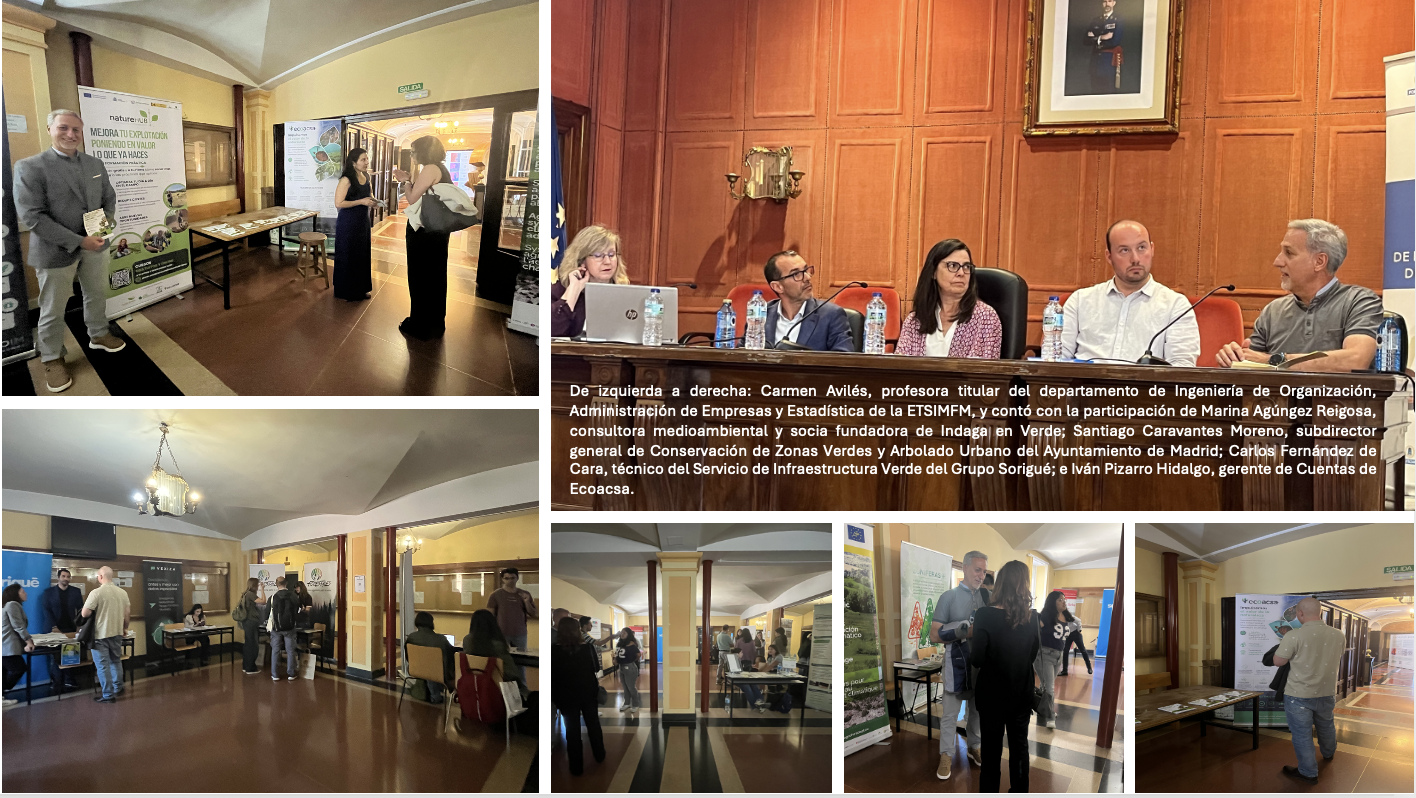
Ayer participamos en la Feria de Empleo Forestal y Ambiental "Your Future in Green: Technology, Nature and Industry in the Ecological Transition" de la School of Forestry, Forest Engineering and Natural Environment at the Universidad Politécnica de Madrid, a space designed to connect students and professionals with emerging opportunities in the environmental sector.
As part of the event, the roundtable “Green infrastructure, urban forests and new green jobs”was held. It was moderated by Carmen Avilés, Associate Professor in the Department of Organisation Engineering, Business Administration and Statistics, and featured Marina Agúngez Reigosa, environmental consultant and co-founder of Indaga en Verde; Santiago Caravantes Moreno, Deputy Director General for the Conservation of Green Areas and Urban Trees at the Ayuntamiento de Madrid; Carlos Fernández de Cara, technician at the Green Infrastructure Service of Grupo Sorigué; and Iván Pizarro Hidalgo, Account Manager at Ecoacsa.
The discussion helped translate technical concepts into practical professional insights and highlighted the growing demand for profiles linked to the planning, development and management of nature-based solutions (NbS) in urban environments.
One of the key messages shared was the need to understand green infrastructure as a functional system that connects different natural spaces within the city. Beyond urban trees, it is a network that integrates biodiversity, ecological connectivity and the provision of ecosystem services (ES), contributing to improved urban liveability and climate change adaptation.
In this context, biodiversity is understood as an element intrinsically linked to the functionality of the urban system. Planning interventions is not only about increasing vegetation cover, but about improving its ecological quality, promoting species diversity and generating measurable ecosystem benefits for the city—from thermal regulation to enhanced human well-being.
Another key aspect discussed was the growing importance of data and innovation. The speakers agreed that quantification, measurement and the use of new tools—such as sensors, satellite imagery and artificial intelligence—are transforming how these projects are designed, implemented and managed. This evolution not only optimises planning, but also enables more accurate monitoring of results and helps justify investments in green infrastructure (GI).
From a public management perspective, the discussion also highlighted the complexity of managing large urban green space systems, which require new technological solutions to improve efficiency and respond to citizens’ needs. In this regard, digitalisation and automation were identified as key drivers for advancing towards more effective and adaptive management models.
The roundtable also provided a comprehensive view of the value chain associated with green infrastructure, from planning and consultancy to implementation, innovation and management. This holistic perspective reflects the wide range of professional opportunities emerging in fields such as urban ecological restoration, the assessment and quantification of ecosystem services, and climate change adaptation in cities.
Regarding the profiles in demand, participants agreed on the need to combine a strong technical foundation with transversal skills. The ability to work with data, proficiency in digital tools, adaptability to changing environments, and skills such as proactivity, collaboration and an entrepreneurial mindset are becoming increasingly important in both private and public organisations.
Finally, a clear message was conveyed to students: learning does not end with formal education. Curiosity, a willingness to continue learning, and the ability to embrace challenges and mistakes are essential components of professional development in a constantly evolving sector, where the integration of nature and technology will shape the future of green infrastructure, urban forests and the optimisation of ecosystem services in cities.