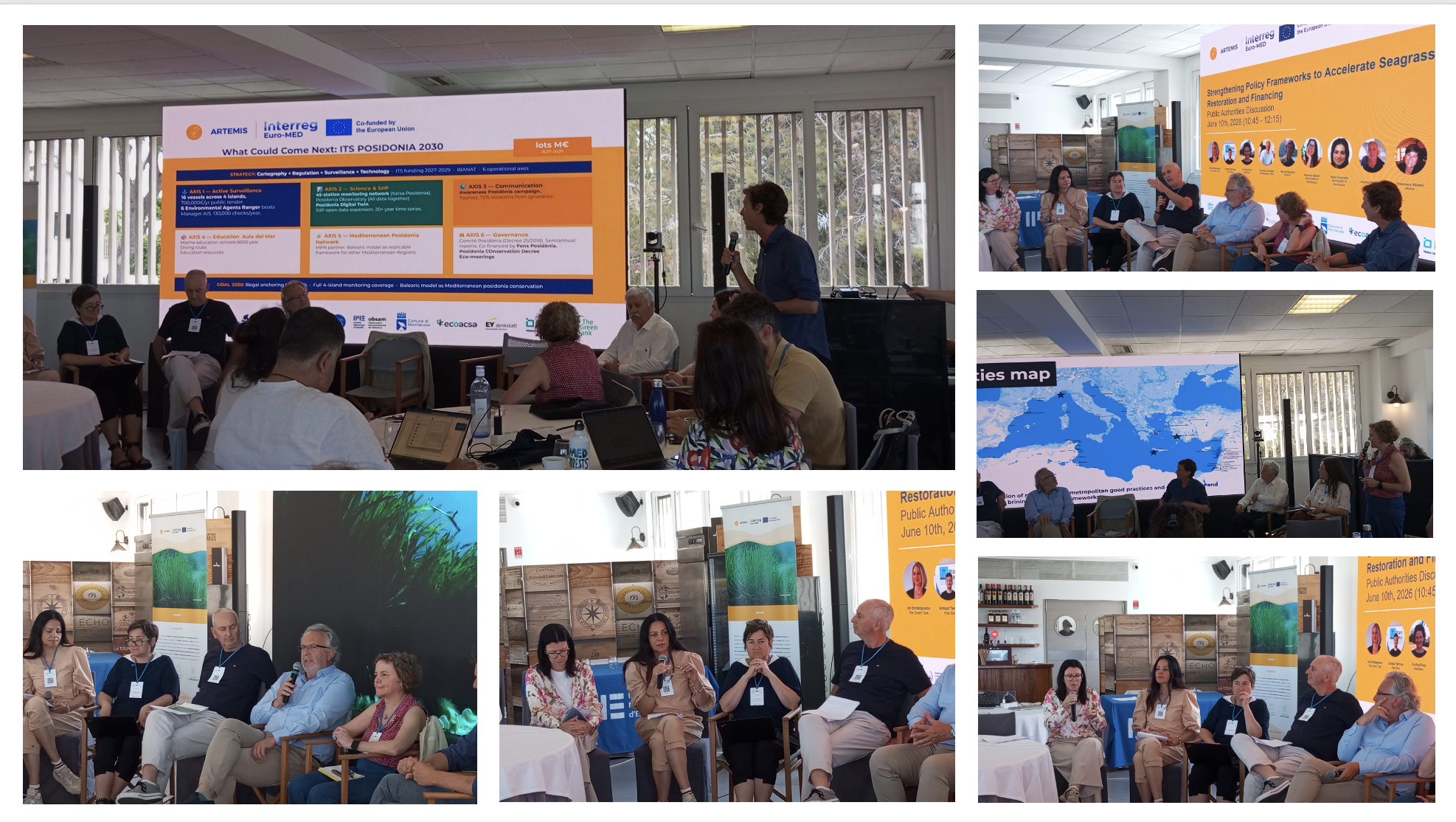
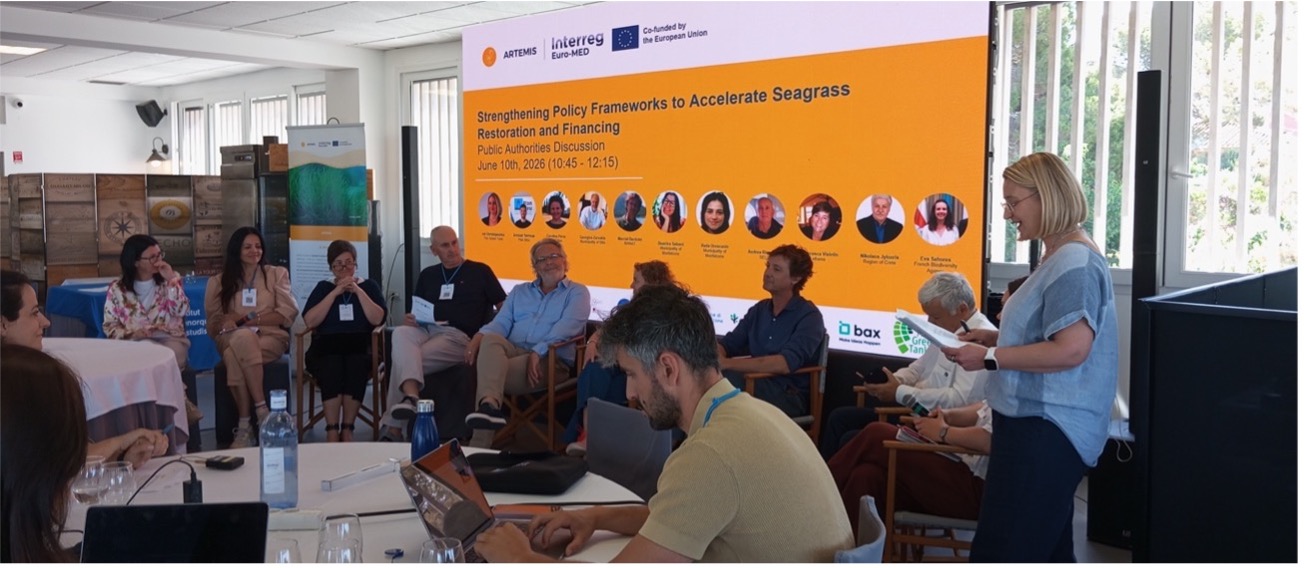
The final day of the project’s Final Conference brought together representatives from national, regional and local authorities in Menorca to discuss how to strengthen governance, planning and financing mechanisms for the restoration of Posidonia oceanica and other marine ecosystems.
The Final Conference of Interreg Euro-MED project concluded on 10 June with a roundtable discussion dedicated to the role of public authorities in seagrass restoration and in the development of policy frameworks capable of accelerating both conservation actions and the financing mechanisms that support them. The session, entitled “Strengthening Policy Frameworks to Accelerate Seagrass Restoration and Financing”, brought together representatives from public institutions operating at different administrative and territorial levels across the Mediterranean.
The discussion was moderated by Ioli Christopoulou, Partner & Policy Director at The Green Tank, and featured Eva Sahores, Project Manager of Interreg Community for Nature C4N) and the Mediterranean Posidonia Network at the French Biodiversity Agency; Nikolaos Jylouris, representative of the Region of Crete; Marcial BardoletHead of the Posidonia Seagrass Surveillance Service at the Balearic Institute for Nature (IBANAT); Carolina Pérez, Head of Policy and Knowledge Sharing at MedCities; Georgios Zervakis, Mayor of the Municipality of Sitia; Beatrice Salzani, Municipality of Monfalcone; Rada Orescanin, Public Relations and Regional Promotion Officer at the Municipality of Monfalcone; Andrea Rismondo, Project Manager at SELC Soc. Coop.; and Francesca Visintin, Green Economy Advisor at eframe.
From regulation to implementation: the role of public authorities
In her opening remarks, Ioli Christopoulou highlighted that the current European policy context offers an unprecedented opportunity to advance marine restoration through the EU Nature Restoration Regulation and the commitments adopted at the Mediterranean level. However, she also stressed that significant challenges remain in ensuring the effective implementation of restoration and conservation measures.
The first intervention was delivered by Eva Sahores, who presented the experience of the French Biodiversity Agency. She explained that the main pressures currently affecting French seagrass meadows are related to coastal infrastructure development and boat anchoring, particularly by small recreational vessels. She also highlighted the Agency’s role in managing protected areas, supporting restoration projects and exploring long-term financing mechanisms capable of reducing dependence on short-term project funding. In addition, she emphasized the importance of Mediterranean cooperation through the Mediterranean Posidonia Network as a means of sharing knowledge and accelerating restoration efforts across the region.
Different responsibilities, shared objectives
From a regional perspective, Nikolaos Xylouris, Deputy Regional Governor for the Environment of Region of Crete, explained how regional authorities integrate seagrass protection into the environmental assessment procedures for coastal development projects. He underlined the importance of incorporating Posidonia conservation into territorial planning and environmental permitting processes, particularly in a context marked by increasing investments in climate adaptation and coastal protection.
For his part, Marcial Bardolet presented the experience of the Balearic Islands, where a specific regulatory framework for the Posidonia oceanica is supported by monitoring, surveillance and public awareness systems.. During his intervention, he highlighted the value of combining regulation, scientific monitoring, social participation and stable funding to ensure the long-term conservation of seagrass meadows.. He also pointed to the role of public fees and financial instruments in supporting protection and restoration initiatives.
The role of cities and Mediterranean cooperation
Representing the MedCities network, Carolina Pérez explained how Mediterranean cities are progressively incorporating marine conservation into their climate and urban sustainability strategies. She noted that many municipalities recognize the ecological importance of seagrass meadows, but still lack the specific tools and competences required to intervene directly in their protection and restoration.
In this context, she highlighted the value of city-to-city cooperation networks in facilitating knowledge exchange, strengthening technical capacities and promoting collaboration with regional and national authorities, research centres and specialised organisations. . She also stressed the need to reinforce multi-level governance mechanisms so that municipalities can play a more active role in marine conservation.
Two territories, very different realities
The roundtable offered an opportunity to compare very different realities across the Mediterranean.
Georgios Zervakis, Major of Sitia, presented the perspective of a municipality closely linked to its natural and marine heritage, and discussed its participation in initiatives developed under the ARTEMIS project. His intervention provided insight into the challenges faced by local authorities working directly on the ground to conserve coastal ecosystems of high ecological value.
Representatives from Monfalcone meanwhile, explained how the city combines a long industrial tradition, port activities, shipyards and energy developments with efforts to protect and restore its coastal ecosystems. Their interventions highlighted the role of European projects in generating knowledge, supporting pilot actions and translating lessons learned into local public policies. They also emphasized the importance of i improving communication with citizens about the benefits provided by seagrass meadows and other coastal ecosystems.
Planning, knowledge and financing as key priorities
During the second round of interventions, participants agreed that marine restoration requires long-term strategic approaches rather than isolated actions. Among the factors identified as essential for accelerating restoration were the existence of clear action plans, access to robust scientific information on ecosystem conditions, the mobilisation of public and private financial resources, and greater citizen engagement in protecting marine natural heritage.
Eva Sahores stressed the importance of securing stable financing for restoration and conservation solutions, while Marcial Bardolet highlighted the need to combine active restoration with natural recovery processes, supported by rigorous technical protocols and monitoring systems capable of evaluating long-term outcomes.
Governance, regulation and collaboration to scale restoration
In her closing remarks,, Ioli Christopoulou emphasized that, despite the institutional and territorial differences reflected in the various case studies presented, several common elements emerged across all experiences: the need to strengthen governance, improve coordination between authorities, reinforce planning processes, secure long-term financing and actively engage citizens and other relevant stakeholders in marine conservation.
The session concluded with a shared message from all participants: seagrass restoration depends not only on technical solutions or financial instruments, but also on the ability of public authorities to create stable regulatory frameworks, coordinate stakeholders, generate knowledge and facilitate collaboration among institutions, businesses, the scientific community and civil society. Only through such an integrated approach will it be possible to scale up marine restoration and contribute effectively to the Mediterranean’s biodiversity and climate resilience objectives.
More information about Interreg Euro-MED ARTEMIS project: https://artemis.interreg-euro-med.eu/