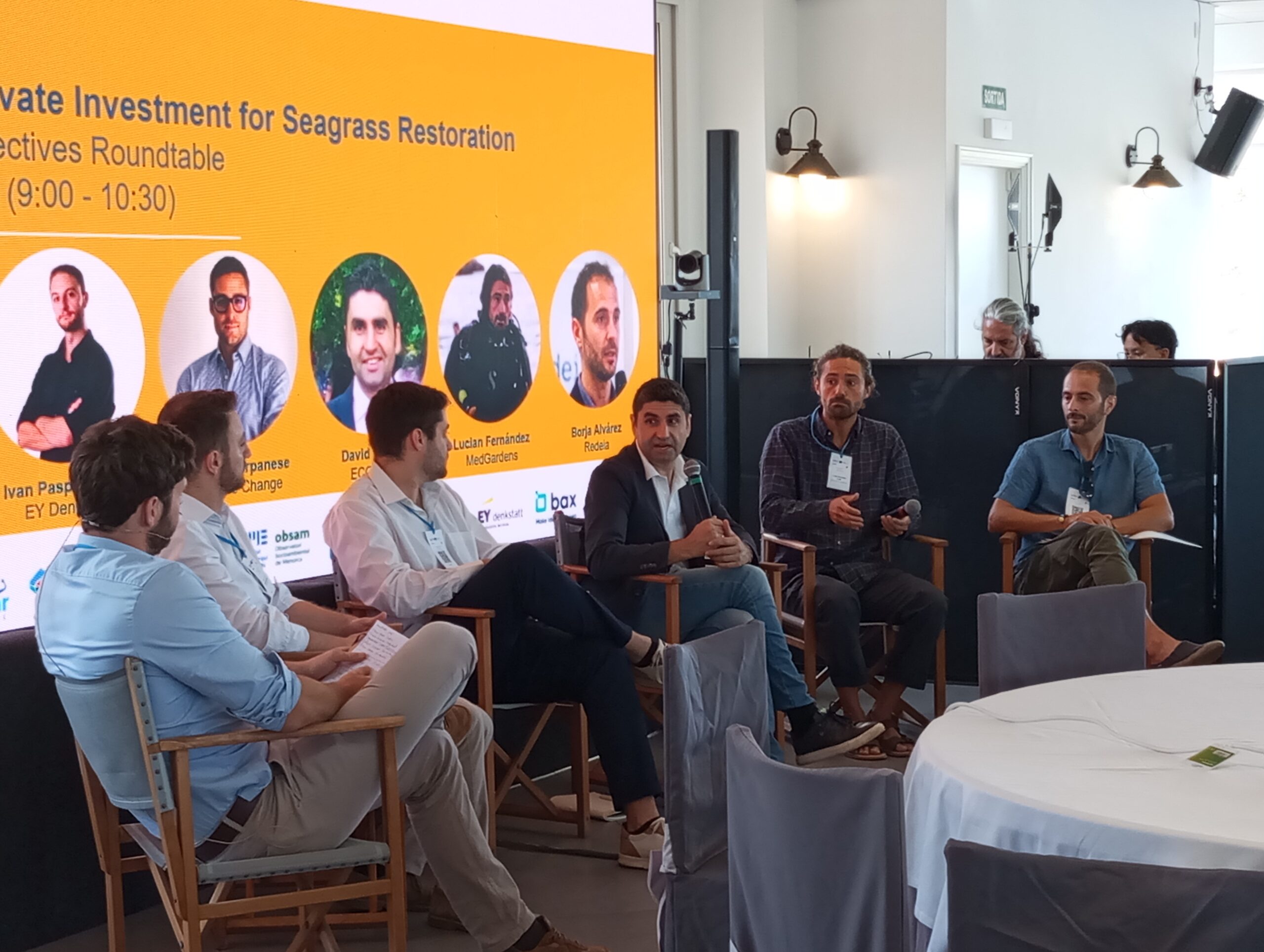
The final day of the project’s Final Conference brings together representatives from businesses, conservation organisations and sustainable finance experts in Menorca to discuss how to mobilise new financing models for marine restoration.
The Final Conference of Interreg Euro-MED ARTEMIS project is holding its final day today at the Club Nàutic de Ciutadella (Menorca), featuring several roundtable discussions dedicated to analysing the future of marine restoration from the perspective of the private sector, public authorities and emerging financing frameworks.
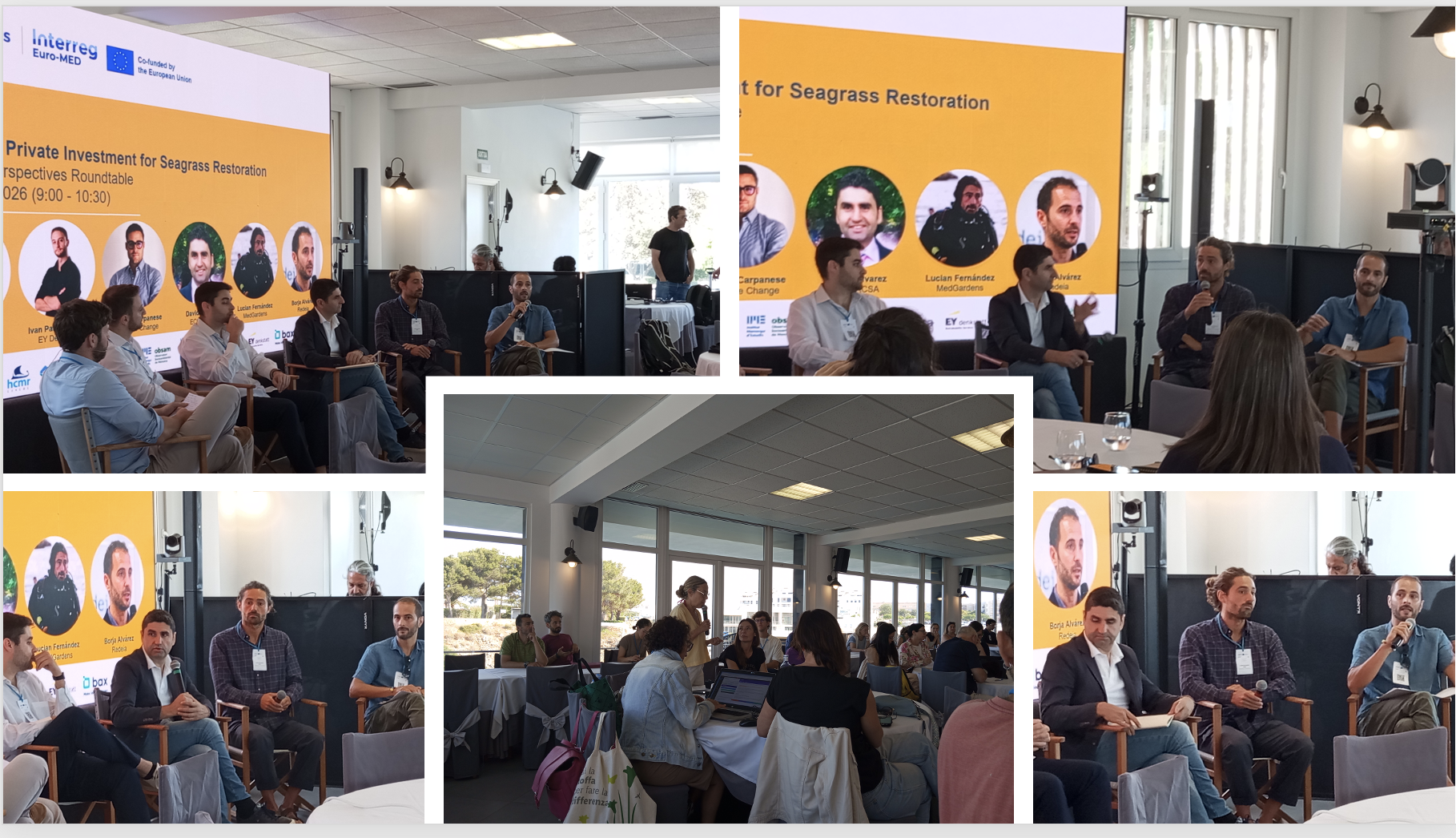
The first roundtable of the morning, entitled “Unlocking Private Investment for Seagrass Restoration: Business Perspectives”, explored how to build the partnerships, funding models and market-based instruments needed to move seagrass restoration from pilot projects to regional-scale impact.
The session was moderated by Ramón Scholl, Innovation Project Lead at Bax Innovation, and brought together Borja Álvarez, Environmental Expert at Redeia; Lucian Fernández Slade, Environmental Expert at Redeia; Lucian Fernández Slade, Environmental Economist at MedGardens Foundation; David Álvarez García, executive director of Ecoacsa; Alberto Carpanese, cofundador de Sea the Change; e Ivan Paspaldzhiev, Senior Manager at EY Denkstatt Bulgaria.
In his opening remarks, Ramón Scholl introduced the session as an open and interactive discussion aimed at exploring the conditions required for seagrass restoration to attract private investment in a credible, scalable and conservation-oriented manner.
From corporate responsibility to marine restoration
Representing Redeia, Borja Álvarez explained the company’s relationship with the marine environment through its submarine infrastructure and its experience in developing initiatives linked to the protection and restoration of marine habitats.
His contribution highlighted that, for companies whose activities are directly connected to the seabed, ecosystem conservation cannot be viewed solely as a reputational issue, but must also be understood as part of corporate responsibility and the effective management of environmental impacts and dependencies associated with business operations.
Financial mechanisms to overcome dependence on short-term funding
Lucian Fernández Slade, Environmental Economist and Scientific Diver at MedGardens Foundation, shared the organisation’s experience in designing and implementing innovative financial mechanisms to attract resources for marine conservation.
From his perspective, one of the main challenges is is overcoming dependence on short-term and project-based funding, which forces many conservation initiatives to devote significant resources to continuously securing new sources of finance. In this context, he emphasised the importance of developing more stable models capable of connecting economic sectors that depend on healthy marine ecosystems, such as tourism, with restoration and conservation projects that generate measurable environmental benefits.
Integrating natural capital into business models
David Álvarez García, CEO of Ecoacsa, provided the perspective of natural capital and market-based instruments for biodiversity. During his intervention, he reviewed the evolution of the business debate over recent years, from an approach focused primarily on environmental impacts towards a broader understanding of nature-related dependencies, risks and opportunities.
Álvarez stressed the need for companies to integrate nature across their business models and decision-making processes. He also highlighted the role of regulatory frameworks, risk management systems and international reporting initiatives as key drivers of a transition that is still at an early stage but is essential for mobilising investment towards ecosystem restoration.
Translating ecological value into economic language
Alberto Carpanese, cofundador de Sea the Change, puso el foco en la the need to raise awareness and strengthen education among businesses, executives and younger generations regarding the relationship between biodiversity, ecosystem services and the economy.
During the discussion, he noted that many companies continue to approach sustainability primarily through compliance requirements, reputation management or supply-chain demands, without yet fully incorporating the value of nature into strategic decision-making. In this regard, he emphasised the importance of developing metrics, tools and incentives that can translate the ecological value of marine restoration into economic arguments that businesses can readily understand and act upon.
Bringing nature into accounting and risk management
Ivan Paspaldzhiev, Senior Manager at EY Denkstatt Bulgaria, contributed the perspective of strategic consulting and sustainable finance. His intervention focused on the need to better connect ecological science with business and financial decision-making, ensuring that environmental outcomes can be effectively incorporated into corporate strategy, risk management and reporting systems.
Paspaldzhiev highlighted that biodiversity is becoming increasingly relevant within corporate agendas, but warned that scientific information alone is not sufficient to influence decision-making unless it is embedded within the standards, accounting systems and incentives that shape corporate behaviour. In this regard, he argued that properly recognising the value of nature and the financial risks associated with biodiversity loss will be essential for marine restoration to move beyond isolated voluntary actions and become part of mainstream business practice.
A discussion on scale, regulation and collaboration
Throughout the roundtable, participants agreed that seagrass restoration delivers significant environmental, social and economic benefits, including biodiversity conservation, enhanced coastal resilience, blue carbon storage and support for sectors such as tourism and fisheries.
However, they also stressed that mobilising private investment at scale will require progress on several fronts: improving the measurement and communication of restoration benefits, developing credible financial instruments, establishing clear regulatory frameworks, strengthening collaboration between public and private actors, and creating incentives that enable businesses to integrate nature into economic decision-making.
The session concluded with a shared message: marine restoration cannot be scaled up solely through public funding or isolated pilot projects. Achieving regional impact across the Mediterranean will require new partnerships between businesses, public authorities, financial institutions, scientific organisations and local communities, together with mechanisms that rigorously recognise the value of marine ecosystems and channel resources towards their long-term conservation.
More information about Interreg Euro-MED ARTEMIS: https://artemis.interreg-euro-med.eu/